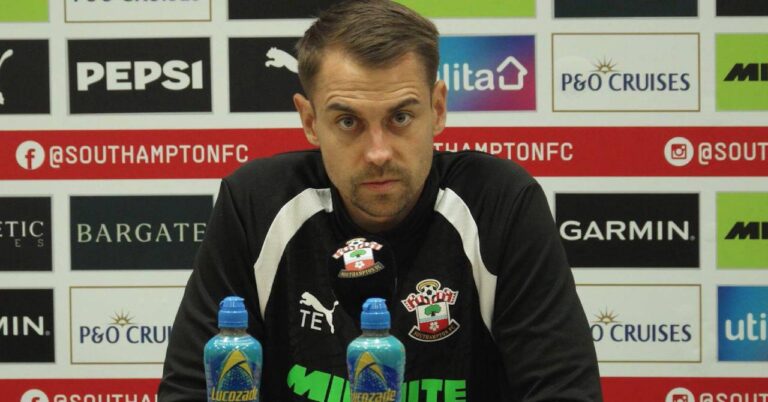

Southampton have questioned the independence of the disciplinary panel that expelled them from the Championship play-offs over “apparent historic and indirect connections of two panel members to Middlesbrough“.
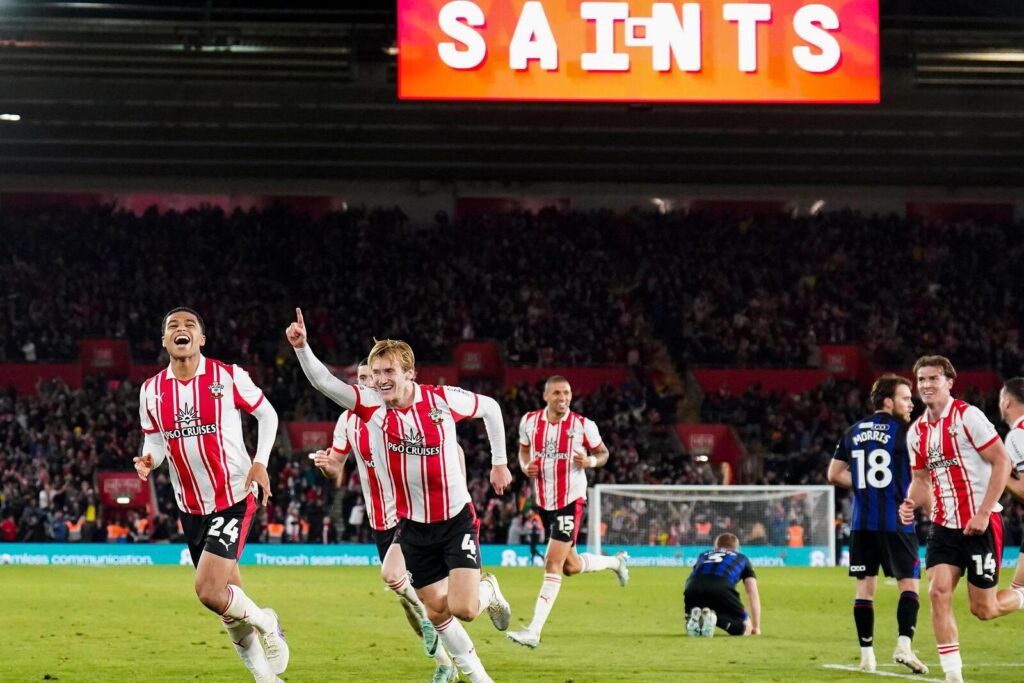
The Saints were expelled from the play-offs after admitting to charges of spying on Middlesbrough ahead of their semi-final tie, which Southampton won 1-0, and ahead of regular-season games against Ipswich Town and Oxford United.
In addition to being kicked out of the play-off final against Hull City, Southampton were handed a four-point deduction for next season.
The club appealed, alleging the punishment was “manifestly disproportionate”. However, that claim was dismissed, by an arbitration panel.
Middlesbrough took Southampton’s place in the final at Wembley, only to suffer a 1-0 defeat to Hull City as the Tigers won promotion to the Premier League.
Arbitration panel reveals written reasons for Southampton decision
In the arbitration panel’s written reasons for its decision, it was detailed that Southampton appealed on the grounds that they had insufficient time to gather evidence relating to the charges of spying on Ipswich and Oxford, and that the sanction was excessively severe.
The club made the latter claim by stating that three points were not properly taken into account by the independent disciplinary commission in handing out the punishment.
Those three points were that “the Club derived no sporting advantage from any of the three incidents”; “the Club made admissions at the earliest opportunity in respect of each of the three incidents and showed exceptional levels of cooperation in the course of the EFL’s investigation and the disciplinary proceedings”; and that “the available precedents in relation to the observation of opponents and other integrity-related infringements with which the sanction imposed by the Commission was wholly inconsistent.
The first claim of procedural unfairness relating to the Ipswich and Oxford incidents was flatly dismissed as having “no force” by arbitration panel chair the Rt Hon Sir Gary Hickinbottom, who later summarised that any potential for mitigation because of Southampton’s remorse was tempered by the club’s initial “misleading response” to the EFL following Middlesbrough’s original complaint on May 7.
The panel chair also deemed that precedent was against Southampton, with Swindon Town’s expulsion from the EFL Trophy for fielding two ineligible players a point of reference. A non-sporting sanction was viewed as “ineffective, if not positively perverse” given the value of the prize on offer through the play-offs, while a simple points deduction was deemed inappropriate for a knock-out competition.
In relation to the assertion that Southampton gained no sporting advantage, Hickinbottom wrote: “The whole purpose of the cheating was to obtain a sporting advantage over the Club’s rivals in the Championship. In each observation, information as to formation etc was obtained. The Commission was not persuaded that this was an exceptional case in which there was evidence that no use was made of the material and therefore no sporting advantage. Indeed, there was evidence of sporting advantage in respect of each of the three incidents.”
Southampton question disciplinary panel
In a response to the findings, Southampton accepted the points laid out in the arbitration panel’s reasons, but the club took issue with the makeup of the disciplinary panel, namely the inclusion of David Winnie and Lydia Banerjee.
Winnie is a lawyer and former football who played one game for Middlesbrough 33 years ago. Banerjee works for the firm Littleton Chambers, which has previously represented Middlesbrough. Winnie has said that any claims of bias on his part are “wholly without foundation”.
Southampton’s statement read: “Southampton Football Club notes today’s publication by the Arbitration Panel of the written reasons behind our unsuccessful appeal of the sanctions the Disciplinary Panel previously imposed on us in the EFL proceedings. We accept that the club breached the relevant regulations, and we recognise that the disciplinary bodies were entitled to conclude that proof of sporting advantage was not necessary in order to establish a serious offence.
“The club accepts that aspects of our initial response to the situation were not treated with the level of scrutiny they required at the time. In hindsight, we wish this had been managed differently from the outset and this represented an error of judgement for which we take responsibility. Despite this, we are happy with the way in which we admitted the charges and offered our full cooperation and honesty once the formal EFL investigation process had started.
“We also note that the club was judged against the very highest standards of integrity and good faith. That is entirely proper. What is harder to accept is that similar scrutiny does not appear to have been applied to the composition of the disciplinary panel itself, given the apparent historic and indirect connections of two panel members to Middlesbrough. While those connections do not by themselves prove bias, they plainly raise legitimate questions about consistency, perception and the standards of independence expected in proceedings of this magnitude.
“The club is also concerned by the weight placed on assertions that junior staff were pressurised into involvement, when some of the most serious allegations appear not to have been supported by direct evidence. That said, junior employees should never have been placed in a position where they felt under pressure, and the club accepts responsibility for that failure of leadership and oversight.
“This case has ultimately been decided on the basis that breach and attempted breach were enough, regardless of whether any sporting benefit was actually obtained. In fact, at no stage was there any finding that the club actually obtained any sporting advantage as a result of the conduct in question.
“That is a severe interpretation, but one the disciplinary authorities were entitled to adopt under the rules as written.
“Southampton Football Club will now reflect carefully on the published reasons, review its internal processes and ensure that governance, oversight and decision-making procedures are strengthened as a result.
“Our responsibility now is to acknowledge what has happened, take ownership of the lessons it brings, and use this experience to strengthen our judgement, discipline, and integrity moving forward together as a club.”
You Should Also Read